What Is Soccer IQ? A 10-Item Self-Test for the 3 Cognitive Components and How to Train Them
Soccer IQ is not a vague compliment — it is a measurable cognitive capacity. Vestberg et al. (2012) ran the Design Fluency Test and the Trail Making Test on 57 male and female professional players in Sweden and found that scores significantly predicted the number of goals and assists each player would produce over the next two seasons (DFT: r = 0.475, p < 0.001). In other words, players who deliver results on the pitch win on cognition, not on athleticism alone. This article breaks Soccer IQ into its three core components — executive function, working memory, and attention shifting — and shows how youth players can train each one.
What Is Soccer IQ — Cognition, Not Athleticism, Decides Outcomes
Soccer IQ refers to the cluster of cognitive abilities a player uses to read the situation, compare options under time pressure, and execute the best one. Vestberg et al. (2012) was the first study to show that professional players' cognitive test scores predict on-pitch performance.

Photo by Jeffrey F Lin on Unsplash
"That player reads the game so well." "Such great vision." "Smart play." Coaches and fans use these phrases all the time, and they are not vague compliments — they describe measurable cognitive capacities. In neuroscience terms, Soccer IQ decomposes into three things: executive function, working memory, and attention shifting.
Vestberg et al. (2012), led by researchers at the Karolinska Institutet, administered the Design Fluency Test (DFT) and the Trail Making Test (TMT) — standard neuropsychological tests of prefrontal executive function — to 57 male and female professionals from the Swedish top divisions. Even after controlling for age, height, and club, test scores predicted the next two seasons' total of goals plus assists with high statistical significance (DFT: r = 0.475, p < 0.001 / TMT: r = 0.357, p < 0.01).
Soccer IQ is not a fuzzy "natural genius" trait. It is prefrontal cognitive function that you can measure and train. That is the headline finding of the Vestberg work.
What makes the result powerful is that cognitive scores predicted future performance independently of physical metrics like sprint speed or VO2max. Cognition has its own predictive lane.
Soccer IQ Self-Test — 10 Items (2 Minutes)
These ten items translate the three components of Soccer IQ into on-pitch behaviour, so you can see which component is your strength and which is your gap. It is not a substitute for a validated neuropsychological test, but it is enough to decide what to train next.
Score each item 2 (clearly true of me), 1 (sometimes true), or 0 (not true), then total it out of 20. The more honest you are, the more useful the result. Keep the per-component subtotals as well as the total — the gap between components is where the signal is.
1. Executive Function (inhibition, switching, planning) — out of 8
- When a defender closes me down, I can abandon my first plan and switch to another option
- Even when a team-mate is calling for the ball, I can hold it if a better option exists
- I go into a match with a plan for how we will attack, and I adjust it myself as the game changes
- Straight after a mistake, I can still make a normal decision on the next play
2. Working Memory (holding and manipulating) — out of 6
- I scan before the ball arrives and still remember where opponents and team-mates were as I take my touch
- I can hold several instructions from the coach in mind and still play
- I remember how the last few phases went and use that to predict what comes next
3. Attention Shifting (multitasking) — out of 6
- I can move my eyes and attention quickly between the ball, opponents, and space
- The moment possession turns over, I switch my head to the new role immediately
- Crowd noise or an opponent trying to wind me up does not stop me returning my attention to what matters
| Total | Reading | What to train next |
|---|---|---|
| 0–7 | Developing | Start by making 'look before you receive' a habit — deliberately increase your scan count |
| 8–13 | Typical | Compare the three subtotals and train the lowest component specifically (see the next section) |
| 14–20 | Strength | Raise cognitive load in game-realistic work (tighter, faster, more options) to make it repeatable |
Compare the executive function / working memory / attention shifting subtotals, not just the total, to locate the gap
This is a simplified self-check that translates the three components into behavioural indicators — it is not a validated neuropsychological instrument like the Design Fluency Test or Trail Making Test used in Vestberg's research. The value is in the gap between components and in the change when you retake it months later, not in the absolute score.
The Three Components — Executive Function, Working Memory, Attention Shifting
Soccer IQ is composed of three measurable elements: executive function (planning, inhibition, monitoring), working memory (short-term hold and manipulation of information), and attention shifting (rapid task switching). Each shows up in a different game situation.
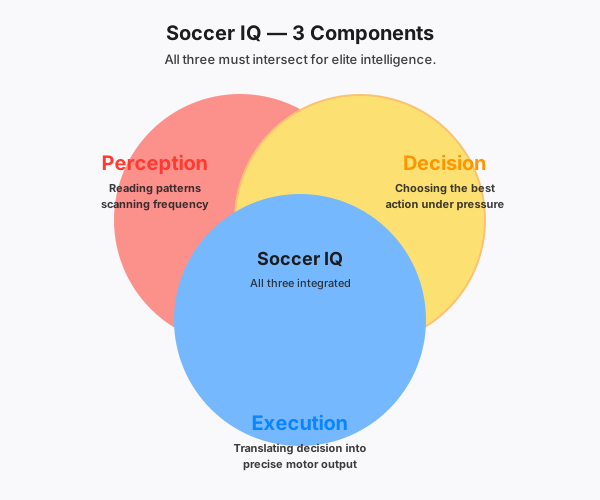
1. Executive Function — Reading the Situation and Planning
Executive function is the prefrontal capacity to compare options, inhibit suboptimal choices, and select the best response. On the pitch this is the player who, before receiving the ball, has already evaluated two or three pass options and chosen the one that breaks the press.
The Design Fluency Test used in Vestberg's study asks subjects to draw distinct figures within constraints in a fixed time — a direct probe of planning and inhibition (the inability to repeat a previous pattern). Professional soccer players scored in the top 5% of the general population on this test.
2. Working Memory — Holding Multiple Pieces of Information at Once
Working memory is the ability to hold visual information (positions of teammates, opponents, the score, time remaining) in your head simultaneously and operate on it. A top player processes roughly four to six chunks of information per second during a match.
Furley & Memmert (2013) demonstrated experimentally that players with greater working-memory capacity also have a wider effective field of vision — the ability to extract information from regions outside the focus of attention. "Great vision" is not better eyesight; it is more working memory.
3. Attention Shifting — Switching Between Attack and Defense
Attention shifting is the speed at which you can move your focus from one target to another. The most consequential moment in soccer is the transition immediately after losing possession — how fast you switch from attacking-mode to defensive-mode directly governs the team's vulnerability.
The Trail Making Test (especially Part B, alternating numbers and letters) measures this capacity. Professionals were 30–40% faster than the general population.
The three components can be measured independently and trained independently. Rather than a generic 'work on cognition,' identify which of the three is your weakness and target that one.
Five Science-Backed Ways to Train Soccer IQ
Soccer IQ is not innate. Brain plasticity research shows that cognitive capacity continues to develop into adulthood, and the gains are larger during the youth window.
1. Cross-Training (Chess and Other Board Games)
Chase & Simon (1973) showed that chess masters perceive the board as meaningful "chunks" rather than individual pieces. The same cognitive mechanism applies when reading player positions on the pitch. Just 30 minutes of chess once or twice a week has shown measurable benefits.
2. Small-Sided Games (4v4 / 5v5)
Compared with 11v11, small-sided games produce 3–5× more touches and decisions per minute. Garcia-Calvo et al. (2014) reported that eight weeks of three-times-per-week SSG training produced statistically significant gains in spatial-cognition test scores in youth players.
3. Constraints-Led Approach
Adding artificial constraints — "three-touch maximum," "weak foot only," "each cone knocked over costs a goal" — forces players to explore options they would normally skip. Davids et al. (2008) ground this in the ecological dynamics framework, and it directly trains cognitive flexibility.
4. Tactical Quizzes (Scene-Recognition Training)
Showing a frozen game state and asking "what should you do next?" with required verbalization is the most direct way to transplant chess-style chunking onto the pitch. Footnote's tactical understanding quiz is built on this method, requiring both an action choice and a written rationale for each scenario.
5. Sleep and Nutrition — The Biological Substrate
Cognitive training does not work without the biological substrate. Vyazovskiy & Walker (2010) found that sleep deprivation reduces prefrontal activity by up to 25%. Junior-high players need 7–9 hours, high-schoolers 8–10 hours (see "Growth Sleep" article for detail).
How to Measure Soccer IQ — Footnote PVS as a Proxy
Soccer IQ can be measured indirectly. Footnote's PVS (Player Value Score) integrates three cognition-dependent metrics — match self-evaluation, growth acceleration, and continuity — into a single composite indicator.

Photo by Salah Regouane on Unsplash
Cognition itself cannot be observed directly, so we capture it through its expression: performance, consistency, rate of improvement. Footnote's PVS embeds the following logic to triangulate cognitive capacity.
- Match Evaluation Score — monthly focus topics (e.g., field-of-vision) self-rated and verified by a coach, integrating subjective and objective signals of cognitive performance.
- Growth Acceleration — the 3-month rate of change across key metrics, quantifying whether cognitive ability is improving.
- Consistency Score — recording streak as an indirect signal that the cognitive system is being stimulated regularly.
PVS is not a literal "Soccer IQ score." But given Vestberg's causal arrow from cognition to results, it is reasonable to use the result-side metric (PVS) as a rough proxy for cognitive capacity.
A rigorous cognitive measurement (DFT/TMT directly administered) requires research labs or sport-psychology specialists. PVS, derived from daily logs, is the practical alternative — accessible to players and coaches and informative enough for everyday use.
Conclusion — Soccer IQ Is a Trainable Capacity
Soccer IQ is not "natural genius" or unmeasurable "sense." It decomposes into three components — executive function, working memory, attention shifting — each of which has specific training methods. Vestberg provided the scientific base; Chase & Simon supplied the cross-training rationale.
The biggest opportunity for youth players is the 8–14 age window — the cognitive golden age — when the right stimulation has lifelong impact. Cognitive training fills the gap that physical training alone cannot reach.
Footnote supports cognitive development through three mechanisms: tactical quizzes, growth-acceleration tracking from continuous logs, and coach verification. Soccer IQ is something you sharpen, and the tools to sharpen it already exist.
References
- [1] Vestberg, T., Gustafson, R., Maurex, L., Ingvar, M., & Petrovic, P. (2012). “Executive Functions Predict the Success of Top-Soccer Players” PLoS ONE. Link
- [2] Chase, W. G., & Simon, H. A. (1973). “Perception in chess” Cognitive Psychology.
- [3] Furley, P., & Memmert, D. (2013). “Working memory capacity as controlled attention in tactical decision making” Journal of Sport and Exercise Psychology.
- [4] Garcia-Calvo, T., Sanchez-Oliva, D., Sanchez-Miguel, P. A., Leo, F. M., & Amado, D. (2014). “Effects of small-sided games on the perceptual and cognitive demands in young soccer players” International Journal of Sports Science & Coaching.
- [5] Davids, K., Button, C., & Bennett, S. (2008). “Dynamics of Skill Acquisition: A Constraints-Led Approach” Human Kinetics.
- [6] Vyazovskiy, V. V., & Walker, M. P. (2010). “Sleep and the cognitive consequences of inadequate rest” Frontiers in Neuroscience.
Related Articles
How Chess Transfers Tactical Thinking, Anticipation, and Pattern Recognition to Soccer
10 min read
Anticipation and Reading the Game — The Science of Prediction That Racket Sports Can Teach You
11 min read
How to Develop Decision-Making in Soccer — What Cognitive Science Reveals About 'Smart Players'
14 min read
Spatial Cognition — The Science of Reading Space, Trained Through Team Sports
10 min read
Metacognition Training — 'Thinking Soccer' Through Journaling
12 min read
Track Your Growth with Footnote
Just record your matches — AI analyzes every 5 games. Visualize growth with PVS Score. All features free during beta.
30-second signup · No credit card required
Last updated: 2026-07-16 ・ Footnote Editorial